

Over the past year, we’ve made a deliberate shift in how we describe our work. From migration to movement.
Not because the issues have changed, but because the lens has. Movement allows us to see more: the flows of people, ideas, goods and culture that shape our world and the systems that enable or restrict them. It happens not only between the lines on a map, but within the spaces we move to and from: markets, cities, stadiums and stages.
This, pencilled by the voices of LAGO, is a reflection of that shift.
Dear Reader, this is LAGO.
Setting the stage - Marta
Showing, not telling
I think of the stage first and foremost as a physical object: a wooden platform, held together by screws and nails, built in a specific place and with a specific purpose: to provide someone with a platform, a perimeter and a physical space, to perform.
A staged performance is intentional and the intention is to share, to show and not just tell.
This is what I now realise I have done by creating LAGO: I chose to perform the beauty of movement in front of others, on a stage, in front of audiences that before I could not reach. I needed a stage to walk onto so that we could stop telling the story of migration and we could start showing and performing the Beauty of Movement.
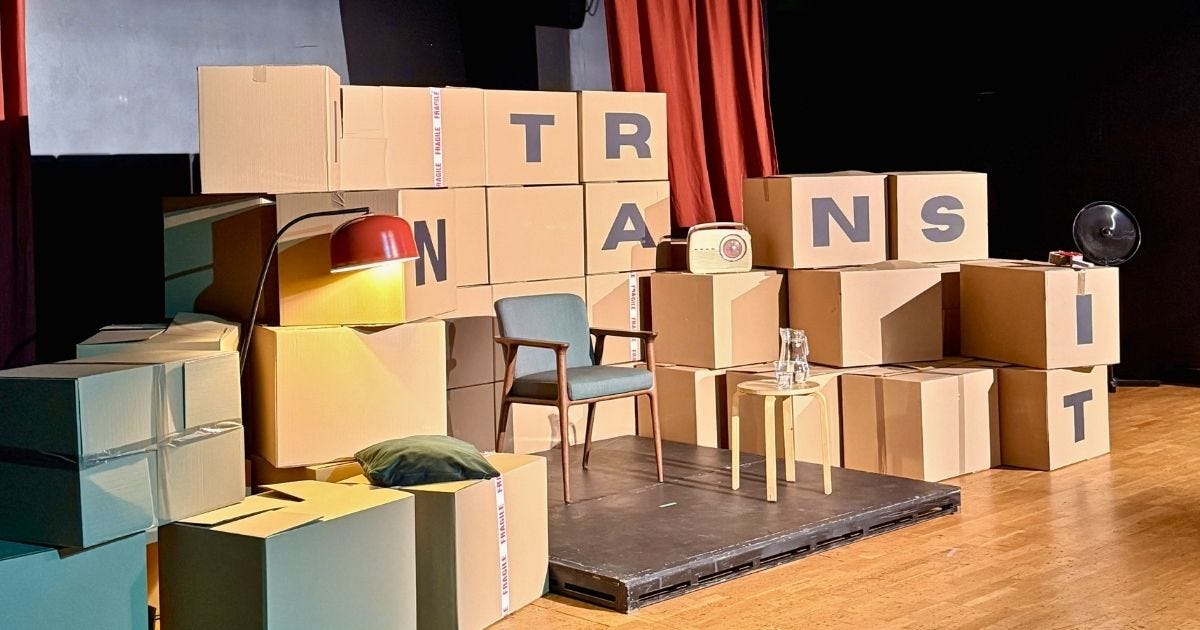
Image credit: In Transit by LAGO and In The Dark, Oxford House, London
The stage is also the space where theatre comes to life. The ‘formal’, ‘proper’ space where hours of rehearsals and practice become a play, a dance sequence, a monologue, a work of art: there is something about practice becoming art that I relate to, as a dancer and as a spectator. But there is also a larger stage, where everything we thought we knew is now changing: geopolitical dynamics, power structures, those who call the shots and those who fire them. The cast is changing. The main actors of the global stage (rich countries, multilateral institutions, old alliances) feel like they have had one too many revivals. What is desperately needed now is not just new ideas, but new actors and new institutions. A new cast, a new crew.
“Whoever steps next onto the global stage will need to have some damn good and practical proposals to address the reality of the global movement of people.”
There will be no future, certainly no European future, without African futures. There are no global supply chains without greater mobility of labour. There will be no biennales, Oscars academy awards, Glastonbury festivals, or football world cups without ‘foreign’ talent. The movement of people is essential for all this: for economies, culture, for our collective future. At LAGO we stage small, beautiful and courageous performances to show, not just tell, the beauty of movement. We cannot wait to see you in the audience soon.
Floating islands - Beatrice
Cities are never still
I’ve always been afraid of stillness. When I first arrived in Venice, I thought I had found it. “Qui non si muove niente” - nothing moves here.
It looked exactly as you would imagine it: a postcard city. Still, preserved, almost frozen in time. San Marco, Rialto, gondolas drifting slowly through quiet canals. But that impression didn’t last.
Living there, I realised how misleading that surface can be. Venice is not still, it moves differently. Beneath its calm exterior is a dense, living system of relationships, rhythms and dependencies. A city made of fragments: over a hundred islands, connected by hundreds of bridges, each with its own identity, yet impossible to understand in isolation.
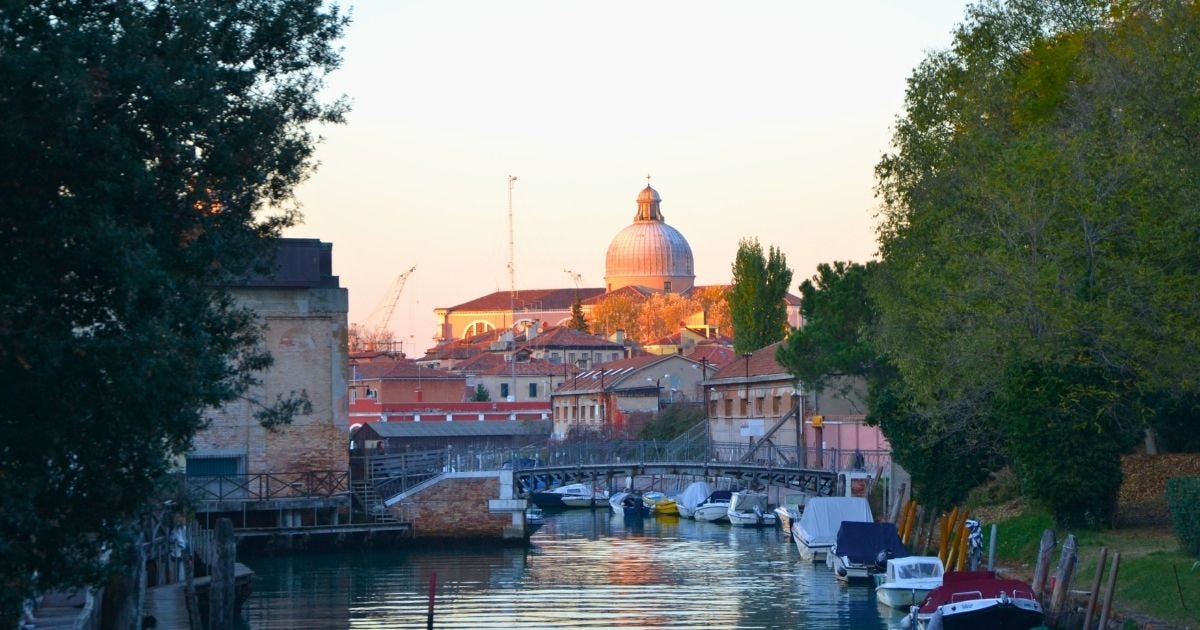
Image credit: Giardini, Venice
What appears static is, in fact, constantly shifting slowly and persistently, over time.
At LAGO, we often speak about borders as lines that divide. In Venice, they dissolve into water. Water that reshapes, redistributes, reconnects. Water that makes movement inevitable and interdependence unavoidable. This is what Venice teaches us: that complexity doesn’t always announce itself. It sits beneath the surface, resisting simplified narratives, asking us to look again.
Our work on cities is grounded in this idea. Cities are not fixed containers, but living systems shaped by movement, by the people, ideas and cultures that pass through them. As we expand our work in Italy and Southern Europe, we are interested in places where history, creativity and movement intertwine in subtle but powerful ways.
“Not all movement is loud. Some of it happens slowly, but it is no less transformative.”
The market as the method - Ruby
Value is always in motion
I have come to believe that instead of reinventing circularity, we need to pay closer attention to the people and ecosystems that have always practiced it.
Before joining LAGO, I learned this at the market. When my mum moved to London, she began selling at Portobello Market, and I grew up spending weekends among stalls, traders and negotiations.
Markets taught me that value is not fixed. It is made, exchanged, reimagined. The exchange of an object is always accompanied by something else: knowledge, trust, a shift in perception.
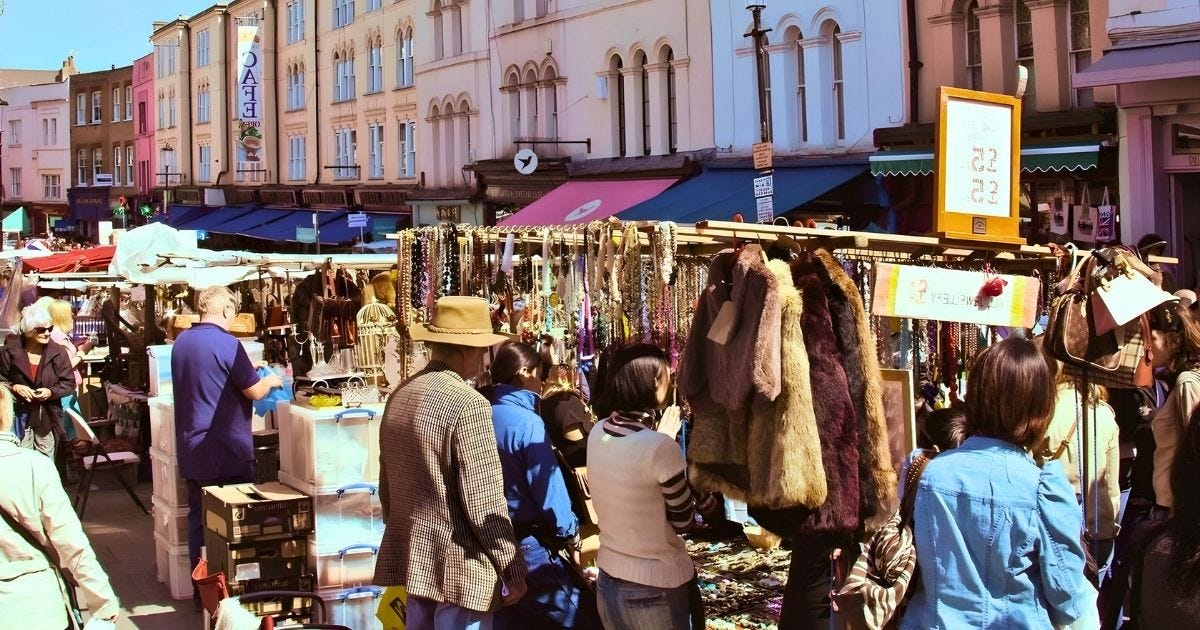
Image credit: Portobello Road Market, Notting Hill, London
This is why markets are the original circular ecosystems. Waste does not really exist there, only materials waiting for a second life. What matters is not just the object, but the imagination applied to it. Working with The Revival has deepened this understanding. Circularity is not a policy or a trend but a lived practice, a site where goods are constantly transformed, where value is renegotiated and where global systems of production and consumption become visible.
“It also challenges the idea of “away”. There is no such place. What we discard does not disappear. It moves.”
This perspective is shaping our work. It allows us to move beyond narrow definitions of sustainability and instead focus on the flows that connect people, materials and places. For us, circularity is not about fixing a system. It is about recognising the systems that already exist and learning from them.
This is The Beauty of Movement: a continuous process of exchange, adaptation and reinvention.
The stadium as a public good - Kenji
Where culture becomes value
When money and culture meet properly, something happens.
Sport and football in particular, is one of the few places where that meeting happens again and again. Emotion doesn’t sit outside the economy, it drives it. Loyalty is built over time, tied to place, repeated weekly. It doesn’t just create culture; it sustains an entire economy around it.
I feel this most clearly in a football stadium, one of my happy places where 90 minutes is both an eternity and a blip in time. Thousands of people travel to a single space crossing neighbourhoods, cities, countries and continents. The chants, the tears, the inheritance of allegiance passed through generations. That experience is not accidental. It is designed.
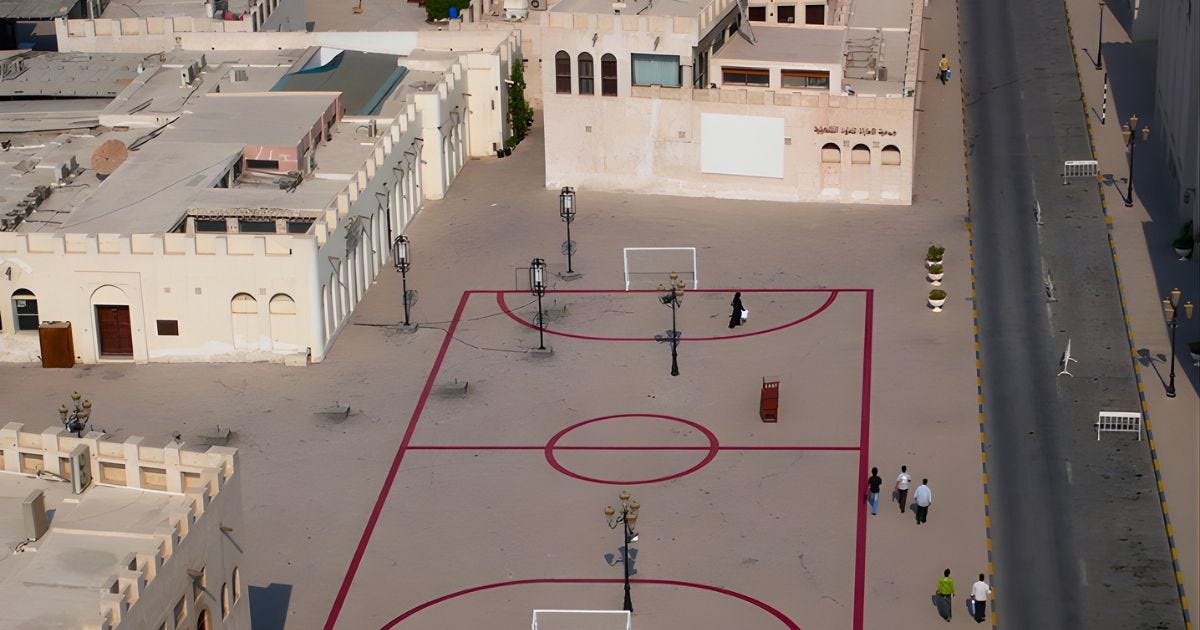
Image credit: Football Field by Maider López, 9th Sharjah Biennial, Sharjah
Stadiums are multi-use infrastructures built to organise movement, to host attention, making space for concerts, matches, performances and cultural events. And in doing so, they make something else visible. They reveal how cultural experience becomes economic value. Cities invest in stadiums for what they unlock: tourism, visibility, revenue, relevance. Public money, private capital and cultural production converge in one place. That alignment shapes how space can be empowered and how money moves.
At LAGO we often speak about culture, creative production and knowledge as public goods. As things that generate shared value. Stadiums show us what happens when that value is recognised, structured and sustained. At scale.
“A stadium is not just a venue. It is a space designed to hold multiple forms of collective joy.”
And so it stands that movement is not abstract. It is shaped by so much and we are tracing these connections across culture, policy and the arts. We are writing and weaving. We are dancing and resting. We are learning and questioning. We are building and becoming.
We hope you’ll stay with us as we do.
With curiosity and joy,
LAGO