

Our latest analysis of official European Commission data shows that in 2025, rejected short-stay visitor visa applications amounted to €157.1 million, up from €145.1 million in 2024 and €130 million in 2023. Behind that figure are hundreds of thousands of people from some of Europe’s closest trade and diplomatic partners, turned away from a holiday, a business meeting or a family visit.
The scale and trend
The cost of visa rejections has risen for the third consecutive year. Across 2023, 2024 and 2025, the cumulative cost to rejected applicants has reached €432 million, paid by people who received nothing in return.
The €12 million increase between 2024 and 2025 was largely driven by the application fee rising from €80 to €90. That policy decision raised the cost of rejection. One in four euros of the new financial burden fell on African applicants, who absorbed €3 million of that additional cost alone.
The impact on lower-income countries
The pattern in the data is consistent and has held across every year of LAGO’s analysis: the lower a country’s GDP per capita, the higher its Schengen visa rejection rate. The criteria used to assess applications, cash in the bank, property ownership and employment status, systematically disadvantage applicants from countries where those markers of wealth are harder to demonstrate on an online form.
The highest rejection rates in the dataset tell that story plainly. Bangladesh: 54.5%. Senegal: 51.9%. Nigeria: 47.8%. Pakistan: 46%. Angola: 45.4%. In these countries, nearly one in two people applying for a short visit to Europe is turned away.
Africa and Asia together account for 90% of the total cost of visa rejections, around €140 million. One third of the global total, around €55 million, comes from just four countries: Turkey, Algeria, India and Morocco. For these countries, the sheer volume of applications drives the cost.
The profound difference in outcomes
The disparity in outcomes across nationalities is stark. Nigeria submits one sixteenth of the applications China does yet pays two thirds of China’s rejection cost. Nigeria’s rejection rate is 47.8%. China’s is 4.1%. Same system, same fee, profoundly different outcomes.
Angola’s rejection costs rose 177% in a single year, from €1 million to €2.9 million, the steepest increase of any country in the dataset. No single explanation is publicly available for that rise and its absence is part of the problem.
The UAE appears as the sixth highest cost country in the dataset, with €6.4 million in rejection costs and a 24% rejection rate. This likely reflects the large population of internationally mobile professionals based in the UAE who face significant barriers to a short visit to Europe despite being economically active and globally located.
The Brexit effect
The cost of rejections from European consulates rose from €7.5 million to €9.7 million, driven largely by an increase in costs from UK-based applications, from €2.7 million to €4.8 million, a 74% rise in a single year. Since the data records where applications are submitted, this likely reflects increased numbers of non-EU nationals based in the UK after Brexit applying for Schengen visas.
The foreign policy contradiction
The countries bearing the highest rejection costs are not peripheral to European interests. They are central to them. Algeria and Morocco are at the heart of EU energy security and migration diplomacy. India is a strategic partner of multiple member states. Nigeria is one of Europe’s most significant African trade partners. Turkey has been an EU candidate country for decades.
The visa system is at direct odds with Europe’s own political and economic interests, and that contradiction has a very price tag. €157 million in 2025. €432 million over three years.
“€157 million paid simply for asking to visit Europe and being told no. A €10 fee increase might seem negligible to Europeans, but it added €12 million to the burden on the countries Europe calls its partners. We call this a reverse remittance: money flowing from those with less to those with more.
What does the visa system reveal about who Europe considers a legitimate traveller and what it costs, financially and politically, to maintain a visa regime that functions as a tax on tourism, business, trade and aspiration?”
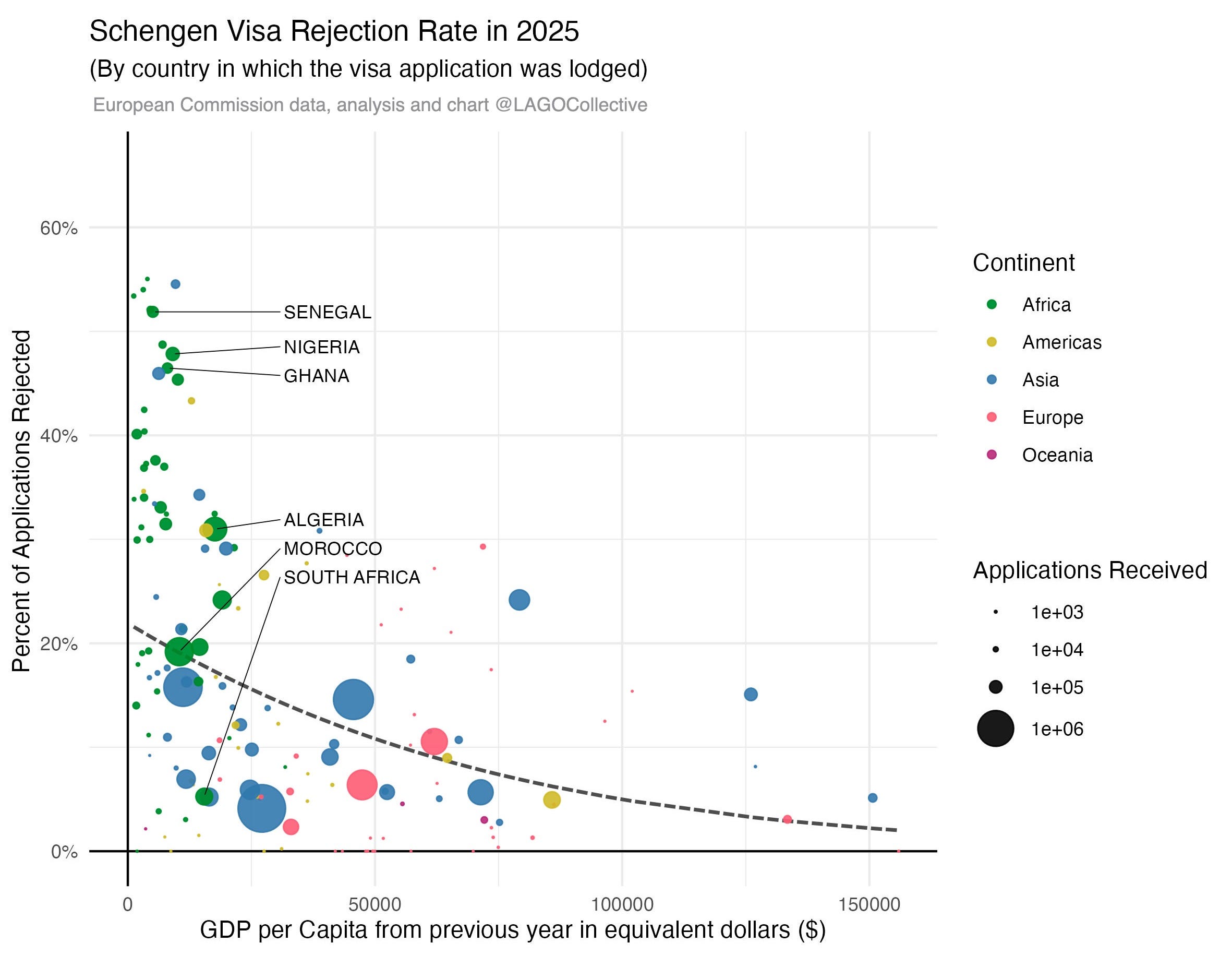
Credit: LAGO Collective and Verdiana Pasqualini
METHODOLOGY NOTE
Rejection costs are calculated by multiplying the total number of rejected applications by the applicable visa fee. For 2025 the fee is €90, following an increase from €80.
Data source: European Commission Schengen visa statistics. Data covers short-stay visa applications (tourist visas) submitted at consulates worldwide for travel to the Schengen Area countries. It does not cover work visas, student visas, long-stay visas, or settlement applications. These figures relate to short-term visitor visas only.
Data on GDP per capita are estimated and made available by the World Bank, on their website. We have used the “GDP per capita, at purchasing power parity (current international $)” indicator as a basic measurement indicating average wealth per nation.
When referencing this analysis, please acknowledge Marta Foresti - Founder, LAGO Collective & Visiting Senior Fellow, ODI Global, Otho Mantegazza - Research Scientist, Data Analyst and Verdiana Pasqualini - Data Analyst.
Full dataset available here.
ABOUT LAGO
LAGO is a research and creative collective on movement, culture and the arts whose mission is to change and reclaim the narrative on the global movement of people.
Our analysis is based on official government and institutional data sources and is made freely available as a public good. This work is part of ‘All Other Passports’, a research and creative project on the impact of visa inequality funded by the Robert Bosch Stiftung.
Check out our work
Website: www.lagocollective.org
Instagram: @lago_collective